"Photography," says Amy Wise-Bacis in her introduction at the business networking site
Linked-In, "is how I express my view of the world. It’s seeing the beauty in the abnormal and mundane. It’s capturing fleeting moments in time. It’s like walking down the street and viewing life through my own personal view finder.
"Photography allows me to appreciate my surroundings, and this is why I love it. When I’m out in the field, the world dissolves. I’m only left with my gear and my subject. Life becomes simple. I hope this is what my images convey to you. My goal is for you to share the simplicity, beauty, and sense of moment I felt when I took the image."
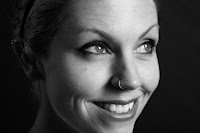
To this end, in the past year and a half, Amy expanded her photography pursuits to step beyond her commercial photography career to begin marketing and selling her landscape and fine art images as part of
Amy Wise-Bacis Photography in San Diego. She still does commercial work and maintains a separate
Web site to handle and sustain those interests, which include architecture, travel, events and portraiture.
Amy took time recently to discuss her work and her craft.
Amy, how did you get into the craft, and when? Was it a sudden thing, or an interest that evolved gradually?
Looking back, I guess it all started with an instamatic-type camera with old-fashioned flash bulbs when I was around 8. Of course, back then I cut heads off of everyone. I got more serious in high school when my parents gave me their SLR Minolta. The camera is older than I am, but it was a great starter camera. Working with film and an older model taught me a lot about photography and how f/stops and shutter speeds work together.
It wasn’t until 2004 that I decided to do it professionally though, when I was asked to be a second shooter for photographer Robyn Hartzell (now in Seattle). I continued to shoot with Robyn through 2007, but by 2005 I also started taking on my own clients and haven’t looked back.
 It’s important for me to add that even though I loved photography in high school, I never comprehended that I could pursue it as a career. I just assumed that I needed to get a 9-5 job and keep photography as a hobby. It wasn’t until my husband told me to get off my butt and go for my dream. The reason I mention this is because I want young readers to know that if they love photography, they shouldn’t be afraid to go for it!
Do you have any favorite photographers who've inspired you or motivated you through the years?
Eddie Soloway has been an amazing mentor to me. He has a very gifted eye and is an incredible teacher. I first learned of Eddie through the Santa Fe Workshop Mentor program and have been working with him since September 2009. In that time, I see things differently and have become a better photographer because of that.
I love Michael Gordon’s black and white work; it’s so powerful. He has done an amazing job of capturing California’s deserts.
Another favorite is Jimmy Chin. His work photographing outdoor adventure is phenomenal! There are pictures of climbers on cliff faces that can make you light-headed. He has an ability to bring the viewer into the excitement. Being an outdoor buff, I greatly appreciate his work.
Also, I spend a fair amount of time online every week looking at photographers (both pro and semi-pro) throughout the world. I’m a firm believer in knowing what others are creating. To limit yourself to famous photographers is a mistake. Inspiration comes from everywhere.

How did you feel about the transition from film to digital imagery? I see from your flickr photostream, you use a Canon EOS 5D, Mark II ... do you ever do any film work anymore? The 5D Mark II is a relatively new camera; what were you using before that, and how have your choices in equipment evolved over the years?
I definitely fought off digital photography for a long time. I only moved to digital in mid-2006 when I purchased the Canon 5D. Although there are elements I miss about film (like sexy film grain), ultimately I prefer digital. As much as I would still like to do film work (specifically black and white so I can develop/print on my own), I don’t have the time. I think the last film image I took was a year ago … sigh.
I have seen a huge improvement from my 5D to my 5D mark II, particularly image size. Now when clients ask for 30x40 prints, I have no doubt that my images can handle the size. Although my camera bodies have changed, I still rely on my Canon L Series lenses. The glass you choose is so critical and aspiring photographers should take note.
Over the years, my choice of lenses has become more finicky. I look at my subject and ask myself, "What are you trying convey in this image? Power? Vulnerability?" Once I answer this, I choose the lens to capture that idea.
One of the reasons I invited you to participate in this feature was because I  noticed you do quite a bit of architecture photography, both exterior and interiors. What got you into that, and talk to us a bit about the equipment you use: Do you use, or ever use, a view camera? Tilt-shift lenses? Ultra wide-angle lenses? If all of the above, how often (and when) do you turn to those for your various projects?
Architectural photography is beautiful. How lucky to create art (the photograph) from art (the building itself). For some this may sound silly, but take a look at Julius Shulman’s work. He created modern-day masterpieces. Because I’m a lover of architecture, I jumped at the opportunity to take on my first architectural project and still love doing these photo shoots.
For equipment, I always find myself using my Canon 17-40mm L Series lens (there’s no crop factor since I am shooting with the 5D II). I also use my level religiously. There’s nothing worse than a crooked building (unless you are very specifically trying to create a different feel with a creati ve angle)!
I have used tilt-shift lenses in the past but find that I can usually capture what I need with my 17-40mm. Working with one lens on a shoot also saves precious time. Be warned, though: At 17mm there can be distortion at the edges. Remember to keep that in mind while photographing.
For both interiors and exteriors I often have to use a flash, strobes and/or reflectors to make sure I get the lighting right. Even when shooting outdoors on a sunny day, shadows can easily get clipped (on the histogram) and I find myself needing to use fill-flash for those areas.

I also enjoyed much of your fine art landscape photography that I found at your flickr stream. The shots taken at Zion National Park, for example, many of which involve catching water streams in a lush texture. What shutter speed(s) are best for those types of shots?
To create the smooth look in the water at Zion’s “Subway” route (below right) I used a minimum of 6 seconds. This of course will fluctuate depending on how fast the  water is moving and the look you want to create. Take for example the image of the cliffs at La Jolla (above). My shutter speed for that image was only 2.5 seconds. Always be careful how long you leave your shutter open, though, because you might end up overexposing certain areas and get blown highlights. This is especially problematic when flowing water hits another body of water and creates whitewash. It’s very easy to blow out your highlights where the two bodies of water converge. Even on overcast days this can be a problem. Always do multiple images varying in length until you get the result you want.
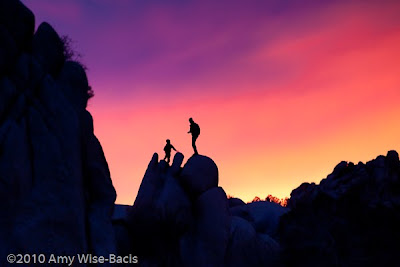
As for the fine detail I noticed ... such as in the clouds and beautiful coloring as in the purple skies in the bluff/silhouette shot at Joshua Tree National Park (at the very top of this post) ... is that attributable more to post-processing work, or do you bracket shots and combine them? Maybe use of polarizing or other filters? Do you ever delve into high-dynamic range work in post-processing?
That image was all mother nature! Winter is the best time of year to capture sunrise/sunset images in Southern California, as was the case in this situation, Joshua Tree National Park. I am not a big fan of heavy manipulation. I RARELY ever use the Saturation feature in Photoshop or Lightroom; I just don’t think it’s necessary.
We seem to live in a world of so much excess that many photographers feel they need to grossly manipulate their work to have it stand out. I work very hard to create a beautiful image without having to do a lot of post-processing. As for HDR, I don’t use it. Not because I’m against it; I just prefer to use tools in the field to get the right lighting. When this isn’t possible, I will bracket. Even then, only about 2% of my work is from bracketed images. Partly because it’s a lot of work, and partly because I’d rather be out in the field than in front of the computer ;-)
The two filters I use in the field are a circular polarizer and graduated neutral-density filter. I don’t use the Grad ND often, though, because it’s a 4”x6” rectangle that does not mount to my camera. I like the speed and flexibility of being able to hold it in front of my lens, but it’s a pain for longer exposures.
Do you have a favorite lens that you find yourself turning to time and again for your landscape shots?
For sure my 17-40mm L lens. I even nicknamed it “Skinny” – get it? Anyway, I love going wide! Sometimes shooting at 17mm proves to be a challenge with getting the right combination of foreground objects not appearing too big and background objects not looking like the size of ants.
 Out of all the places you've visited to indulge your photography craft, is there any one that stands out because of the images you were able to get? Are there places you'd like to visit to ply your craft?
I honestly can’t say that one spot has been better than another to indulge my craft. What I do love is shooting abroad and trying to capture the tone, culture, colors, of that area.  Whether it’s Bolivia, Tanzania, or Cambodia, each place provides endless opportunities and it’s up to me to find them. It’s a pretty stressful process, but ultimately it’s what keeps me planning my next trip!
Right now I have my sights on Turkey because of its unique and vast landscape. In one country you have rich history shown through architecture, mountain tombs, serene beaches and mesmerizing thermal pools. All places I can get excited about!
When did you first start marketing your work? For those who might have ambitions to do that some day, can I ask how difficult it was for the sales portion of your work to "catch on"? Did you do all the marketing work yourself, or did you have help?
I heavily started pushing my fine art prints about a year and a half ago. Prior to that I had just focused on my commercial work and saved the landscape work as personal projects. I guess you could say I had a moment of realization one night and decided that if I was going to survive as a photographer, I want it to be from my landscape work (my passion). At that point, I rewrote my business plan exclusive to selling fine art prints.
As much as I would love help (assistant and/or agent), I handle the marketing on my own. For those considering the world of landscape photography as a career, I will say that it’s about 1,000 times harder than you plan. You need tough skin and great business skills. Lastly, the process never ends. You may think that at a certain level you can kick back and relax, but there is always competition ready to take your spot.
I noticed, also at your flickr stream, that you have some examples of head shots from your portraiture work. One in particular piqued my interest because of the description you provided about the shot. It was a gentleman named Matt and featured a white background. You said you got this effect by "shooting into one of my large softboxes," which you said you prefer over "storing a white backdrop." Did you literally mean you had the softbox directly behind Matt, as if in position to present a classic silhouette? If so, describe how you metered the lighting so as to not underexpose ... and did you need to do much in post-processing to ensure Matt's facial features would otherwise look normal?

This shot was a lot of fun. I setup my large softbox directly behind Matt and set that strobe to a very low power- something like 1/16. I then took my medium softbox/strobe combo and placed it in front of him with a bit more power- around ¼. As you can see from the before and after images (above), there was very little correction that needed to be done. The only challenging part was my placement. I needed to shoot him straight-on but not block my light from the medium softbox. Admittedly, it was an awkward stance, but the result is very pleasing.
If using this technique, be very careful of the light illuminating the ears. The result can be extremely red. Also, I don’t recommend doing this for more than one person (and just a headshot) unless your softbox is enormous!
You also maintain (or try to!) a "teaching blog". I applaud such endeavors by those who are "in the know," and I've read through several posts myself. But I wonder ... how do you find time to sustain it?
 Maintaining a blog is difficult – more so than I realized when I started it ;-) I think it’s important to share knowledge about my industry. The more that professionals share info, the better all of us will be.
From the time I write my blog, find or take the images, proof, upload, launch, and review in all browsers, it’s about a six- to eight-hour process. For example, I launched my latest blog about night photography thinking all was hunky-dory, only to learn that one image wasn’t working in Internet Explorer. This is a perfect example of what owning a photography business is like: Everything takes four times as long (if not longer) than you think it will!
When I decided to start a blog, I wasn’t sure who my audience should be … landscape photographers, lighting gurus, etc. I quickly realized that those who will benefit the most are novice to intermediate-level photographers. The feedback has been great, and I love that I am providing information about topics that help people improve their craft.
My goal (not always reached!) is to publish a blog post every other week. What I don’t want to do is post a blog that lacks value just to be getting something up. My hope is that people will rely on my blog for great tips/techniques, as well as a place to ask questions – even questions they may be a little embarrassed to ask elsewhere.
Are there any types of photography you haven't tried – or haven't done much of – that you'd like to explore? 
Definitely adventure photography – rock climbing, ice climbing, mountain-
eering, etc. I love the outdoors and would love to capture extreme moments in the sports I love. Unfortunately, it’s typically just me and my husband when we climb, and I don’t think he’d appreciate me letting go of the rope to get a great shot ;-)
This is also a very tough field and not for the faint of heart. For example, I have done trips like summit Kilimanjaro, attempted summit of Mt. Cotopaxi (turned around due to avalanche danger), rock climbing in Joshua Tree, white water rafting in Australia, diving the Great Barrier Reef, etc., but this is peanuts compared to the professionals. As my skill level grows, I am hopeful that opportunities will present themselves in the future ;-) Hopefully, someday you will see my work done on Annapurna or K2!
To check out Web sites featuring more of Amy's work, follow any of these links:
Fine art landscape work
Commercial work
Blog, "Teaching Photo Lovers One Blog at a Time"
Facebook fan page
Twitter
Flickr photo stream
 On Saturday, Feb. 6, I returned to Garfield Park, as a sort of follow-up to the shoot of the previous day (see images in previous post), when it snowed nearly all day and skies were gray and overcast.


