Showing posts with label John Mortell. Show all posts

Wednesday, June 1, 2016

An individual look at the "Hamlet" cast

When I arrived to shoot First Folio Productions' dress rehearsal of its spring show, "Hamlet," director Glenn Dobbs told me that in addition to the actual performance, he wanted me to shoot individual photos of cast members from which he could pick an appropriate "album cover." (For a post devoted to my play pictures, see previous post or click on the link in this sentence.)

I didn't ask him about what kind of album he was talking about. Even if I were going to ask him, before I could do that, Dobbs told me he wanted to use the electric bulbs wired into his false brick posts stage props for lighting.

Anyone who knows lighting for photographs knows what kind of pictures will result in the dramatic lighting he was proposing -- modest to wide shadows in and/or under the eyes, or when one side of the face would be illuminated while the other was in dark shadows or turned away from the camera, depending on how you position the subject(s). Portrait photographers know that dramatic lighting can be effective when you seek to present a subject in a certain mood, and that it can work on occasion for male subjects. They also know that such lighting is generally considered unflattering and unappealing for female subjects.

Dramatic lighting is what Dobbs was after, so we went through the full cast trying to position them as best as we could. Dobbs was so excited about the bulb lighting, that when he stood in for a test shot (right), I decided to compose it with one of the bulbs in it. I made both color and monochrome versions of each formal shot. I also made a few informal (candid) color images for Dobbs -- shots from moments during the very short lulls when one individual departed and Dobbs rounded up the next one. And we had to do it fast, because Dobbs needed to get the play rehearsal started on time so we wouldn't be at the theater very late into the evening.

It occurred to me as I processed the images yesterday that it might be of interest to readers here to see what kind of quality can come out of a situation like that. In most cases, I was able to keep the ISO setting on the camera at a reasonable level for my Canon 6D, which can process photos without revealing too much "noise" (or grain) up to about ISO 6400, and sometimes even a bit more. In a few cases, however, I had to push the ISO higher, so while processing the photos, I made decisions to toss a couple shots that would have been usable under better lighting conditions.

From the number of poses we did of everyone, it was clear afterward that Dobbs was looking for one of Hamlet or Hamlet with Ophelia to be on the cover of whatever album he was putting together. We did a lot of different poses with Carey Shea (Hamlet) and of Shea with Devan Mathias (Ophelia). While Dobbs might have his own ideas about what he will want and use, this post is more about how I regarded the results of the shots.

My favorite solo shot of Shea is the one presented in the dual-photo presentation I have leading off the post -- and this dual photo presentation for a lead graphic, incidentally, is a first for Photo Portpourri. Notice the bit of shadow on the right side of Shea's face -- not nearly as dramatic as I would see while exploring and using other poses. In fact, in general, his face in this photo has favorable lighting, and the pensive pose comes off as powerful, I think.

In the spirit of giving credit where it's due, I'll mention here that Dobbs had ideas for poses throughout this quick shoot, and we tried everything he mentioned. He also yielded to me every time I expressed concerns about unacceptable lighting or distracting backgrounds. Indeed, we used his ideas more than half the time, and this one was one of his. To show you examples of what else we came up with, I include a shot of Shea looking directly at the camera (left) and a monochrome conversion of him looking over his shoulder (right).

My favorite of Hamlet and Ophelia (Devan Mathias) together is the one sharing the lead-off spot at the top. Dobbs and I shared the idea for this pose; Dobbs had sought some separation between the two, and when I told him there wasn't ample lighting for both individuals in any separated position without creating a significant depth of field issue (one individual would have to be out of focus), we put Devan in a position facing the camera and gazing at Hamlet. Her face caught a good share of light, so we put her in focus. In the foreground, Shea is prominent ... but thrown out of focus because of the separation.

We took shots of Mathias solo in two poses, one serious, one with her smiling. I think because of what I mentioned above about women come off in an unflattering nature when cast in dramatic lighting, I favor the shot of her smiling (right). For one, it's a genuine, pretty smile, and also I think it goes a long way toward conquering the women-in-dramatic-lighting issue.

Outside of the lead characters, my favorite individual shots -- female and male -- are of Anne Gross and John Mortell (below). Anne has a couple roles in the play, but her main one is as a performer in "The Murder of Gonzago," a play within the play. Even though the right side of her face is cast in shadow (it was virtually unavoidable), I like her shot because of the costuming and how she holds herself in the pose. The latter is also one reason I like Mortell's shot. He exudes confidence, and both individuals have a good sense about how to present themselves. Because I'm familiar with Mortell from previous First Folio shows, I know this is a very accurate representation of his command of the characters he portrays. In "Hamlet," Mortell plays Laertes, brother of Ophelia and son of Polonius.


Here are some more examples of the individual shots:

 Ericka Barker, as Queen Gertrude, Hamlet's mother

Matthew Anderson portrays Claudius, Hamlet's uncle ... and stepfather ... and is the person responsible for the death of Hamlet's father. There were three poses of Anderson, and this one -- which in a way reminds me of his character's critical prayerful scene before intermission in the play -- seems appropriate.


We also did two poses of the "Hamlet" newlyweds, Claudius and Gertrude. In my opinion, this was the better, although I don't like the shadows on Ericka Becker's face.

 Benjamin Mathis as Horatio, Hamlet's friend and confidante.


We did two poses for Tom Weingartner, who plays Polonius, father of Laertes, one with and without a hat. I liked both, so ... here you have them. 

Scott Stockton as Marcellus and an extra. 


Andy Barnett as the ghost of Hamlet's father, King Hamlet. It seemed appropriate to use the monochrome version for the ghost.

Missy Rump as Bernardo and as a performer in the play within the play. Rump and Gross had similar costumes, and the color version of Rump's photo was just fine. I just like how the monochrome conversion came out.  

Chris Burton has several roles, actually. Here he's dressed for a scene early in the play as an extra for the reception of Gertrude and Claudius' wedding. He also performs as the lead player in the play within a play ... and as the gravedigger.  

 Fred Margison plays Osric and an extra.

Kevin Caraher has dual roles as a priest and an extra.

As always, click any individual images to view a larger and sharper version, which is particularly beneficial if viewing this post in a mobile device.

"Hamlet" has its final shows at Ben Davis High School in Indianapolis this weekend -- 7:30 p.m. Friday and Saturday (June 3-4) and 3:30 p.m . Sunday, June 5.  Follow the link in this sentence to learn more about how to get tickets, which cost $12 (seniors get a $2 discount, students a $4 discount).

Photo geek stuff: I used a Canon 6D equipped with a Sigma 85mm f/1.4 lens for all of the individual shots. I shot using ISO 1600, with the aperture varying from f/1.4 (wide open) to 1.8 and the shutter at around 1/125.

Tuesday, May 31, 2016

First Folio brings "Hamlet" to the stage

I've shot full-show Shakespeare productions by First Folio Productions of Indianapolis since its 2014 spring presentation, "Romeo and Juliet." And while First Folio always has done a remarkable job, this spring's "Hamlet" might just be its best yet.

"Hamlet," which is playing at Ben Davis High School in Indianapolis, opened last weekend and has one more weekend of shows -- 7:30 p.m. Friday and Saturday, June 3-4, and 3:30 p.m. Sunday June 5. Check the link in this sentence for ticket information.

I first saw "Hamlet" male lead Carey Shea as the cynical philospher Apemantus in the rarely performed "Timon of Athens," Casey Ross Productions' contribution to last fall's inaugural Indy Bard Fest at Studio 15 in Carmel, Ind. I was struck then by his ability to convey a non-lead but nevertheless important character. When I photographed the "Hamlet" dress rehearsal on May 24, I saw it even more so when he brought Hamlet to life and, alas, to death on the stage.

Devan Mathias was cast in the play's female role lead, Ophelia, and her dramatic meltdown scene gives photographers the thrill we seek in trying to best capture the moment. Kudos go out, as well, to Matthew Anderson, whose portrayal of Claudius, the evil, conniving stepfather of Hamlet, is strong and convincing, reaching its apex in the dramatic soliloquy just before intermission.

Director Glenn Dobbs devoted attention to intensifying the climactic swordfight scene depicted in the photo leading off the post. The scene pits Hamlet (Shea, left) against John Mortell's Laertes. Mortell is a veteran of First Folio swordfight scenes in shows that I've photographed ("Macbeth" 2015 and "Romeo and Juliet" 2014), and directors of Shakespearean dramas no doubt find those skills a welcome complement to his character portrayal acumen.

First Folio's "Hamlet" has had favorable reviews by at least three theater bloggers -- Melissa Hall ("Stage Write"), Ken Klingenmeier ("A Seat on the Aisle") and "Jay Harvey Upstage."

Ah, but this blog is about pictures, not about words (although I'm sure you can find many posts to present as evidence otherwise). Here are a few of the shots from the show, which is likely to be one of my last to photograph, to whet your appetite for the real thing. A full gallery of my shots from the play is available to view at my SmugMug.com site.

Photo geek stuff: I shot the entire production with a Canon 6D equipped with a Canon EF 24-70mm f/2.8L lens. I used a Sigma 85mm f/1.4 lens to shoot individual shots of the cast members, which the director, Glenn Dobbs, asked me to take in addition to the play photos. Those photos are not included in this post but might be represented in a separate post down the road. My settings for the play shots varied according to light conditions and when action on stage was normal or intense. I did shoot using shutter-priority mode for the entire play. For non-action scenes, I was able to shoot at shutter speeds ranging from 1/160 to 1/200; for the climactic sword-fight scene, I raised the shutter speed to 1/640 and set the ISO to 8000 (there was good lighting). My ISO setting was my major variable, as stage lighting varied frequently throughout the show. For lighting at its most optimum point, my ISO was usually from 1600 to 2000; at lighting's lowest point, I used ISOs ranging from 4000 to 16,000 or more (the ghost scene).

Above and below: Throughout Shakespeare's classic drama, Hamlet's relationships with key characters run friendly and violent, the most notable of which is that with Ophelia. Carey Shea and Devan Mathias portray those characters.


Above: A confrontation between Hamlet and Laertes, played by John Mortell. With the help and encouragement of Claudius, Laertes will seek revenge for the death of his father, Polonius, at Hamlet's hand in his mother's bed chamber.

Above: Hamlet with Polonius, portrayed by Tom Weingartner. 

Above: Hamlet has anger issues even with his own mother, Gertrude, played by Ericka Barker.

Hamlet above with trusted friend Horatio (Benjamin Mathis), who later in the story (below) comforts Hamlet in his last moments. First Folio's production takes the unusual step of opening with the denouement ... before presenting the whole story as a flashback. 


Above and below: Ophelia begins her run off the rails in this scene ...


... then completes it shortly afterward in the scene captured in the photos above and next three below.


Above and next three below: Claudius in his soliloquy of anguish and remorse just before intermission, climaxing with the emergence of Hamlet with drawn dagger. Hamlet refrains from using it this time, but Claudius isn't as fortunate in the final scene when the prince follows through. 


Above: In the final scene, Hamlet, moments after his mother had fallen fatally to a swallow of poison that was intended for Hamlet, finally follows through with the slaying of Claudius.

Ericka Barker as Gertrude, Hamlet's mother, in a moment of conversation (above), and in the violent bed chamber scene with her son (next two below).  


Above: Hamlet confronts the ghost of Hamlet's father, played by Andy Burnett. 

Chris Burton (above) and Anne Gross (with Burton, next two below) are the lead player and player queen in the performance of "The Murder of Gonzago," a play within the play that Hamlet devises to replicate the slaying of Hamlet's father. Hamlet hopes the play can help him determine if Claudius was responsible for his father's demise.  


Burton has the dual role of gravedigger (above), who presents Hamlet with a skull, supposedly of Yorick, jester in the court of King Hamlet, prompting a monologue on mortality (below) by the play's lead character.


Monday, October 27, 2014

3 shows remain in First Folio's run
of Shakespeare's Macbeth

The final three shows of First Folio Productions' fall drama, "Macbeth," the classic Shakespearean tale of evil, will be performed this week.

Show director Susan Yeaw, whose production opened last weekend at Studio 15 in Carmel, invited me to shoot the dress rehearsal on Oct. 20, and since then I've been turning around and delivering images to the troupe and Carmel Theatre Company so they can promote the two weekends of shows. First Folio has used several of my images on social media (Facebook, Twitter). Just today, I completed processing the last of the images, so I thought I'd try to get a post up on Photo Porpourri to help spread the word.

This shoot was the most difficult of the dozen or so theatrical productions I've photographed since 2010, primarily because of the frequent and dramatic stage lighting shifts between scenes. One moment, lighting would be what I would describe as relatively normal then shift to pitch black with little time to adjust camera settings to be prepared.

In pursuit of optimum-quality images, I was bouncing back and forth between shooting at available light with high ISOs for the better-lighted scenes, to diffused on-camera flash for the all-dark scenes, the latter using a Canon 580EX II strobe.

Fortunately, my Canon 6D camera had the quality ISO levels to deliver presentable images at most of the ISO settings I turned to, and the Graslon Insight flat amber diffuser (pictured at right) I used on the 580EX II did a great job of lighting my subjects even though I did need to tinker with the intensity and zoom levels periodically.

If you're new to this blog, I wrote two posts mentioning the Graslon diffusers in 2013; the link in the previous clause takes you to the second of the two. Just revert to the post immediately before that one to find the first post. I own Graslon's Insight (flat) and Prodigy (dome) diffusers in both white and amber, and I own a Graslon white Spark that slides onto the hot shoe of my Canon 7D to diffuse light from that camera's pop-up flash. The Insight and Prodigy slip over the flash heads of an on-camera flash. If you need professional light but don't have the time to set up stands and strobes, or because of logistics (such as plays on stage), these Graslons -- especially the Insight and Prodigy -- with a wonderful mirror redistribution light system for on-camera flashes do a great job of delivering the next-best thing.

I was also changing my ISO levels between the high zones for available light to much lower noise levels for flash. I also was changing my shutter speeds between the two lighting sources, going higher in available light (mostly 1/180 to 1/200) to stop action as much as I could, and lower speeds (usually 1/80) for flash to allow for greater background detail to be included when I could. Flash stops most action at speeds of 1/60 or faster anyway. My main concern in switching back and forth so much was that I would forget to remember to return the shutter to the higher speeds when going from flash to available light.

And, alas, that did happen when I started shooting a crucial fight scene near the end. When processing the images at home, I was tossing out a lot of frames because of unwanted blur, although I did preserve a few in which the blur seemed to work.

"Macbeth" can be seen at 8 p.m. this Thursday, Friday and Saturday. Studio 15 is at 15 First Ave. N.E., a block north of Main Street in the heart of Carmel's Arts and Design District.

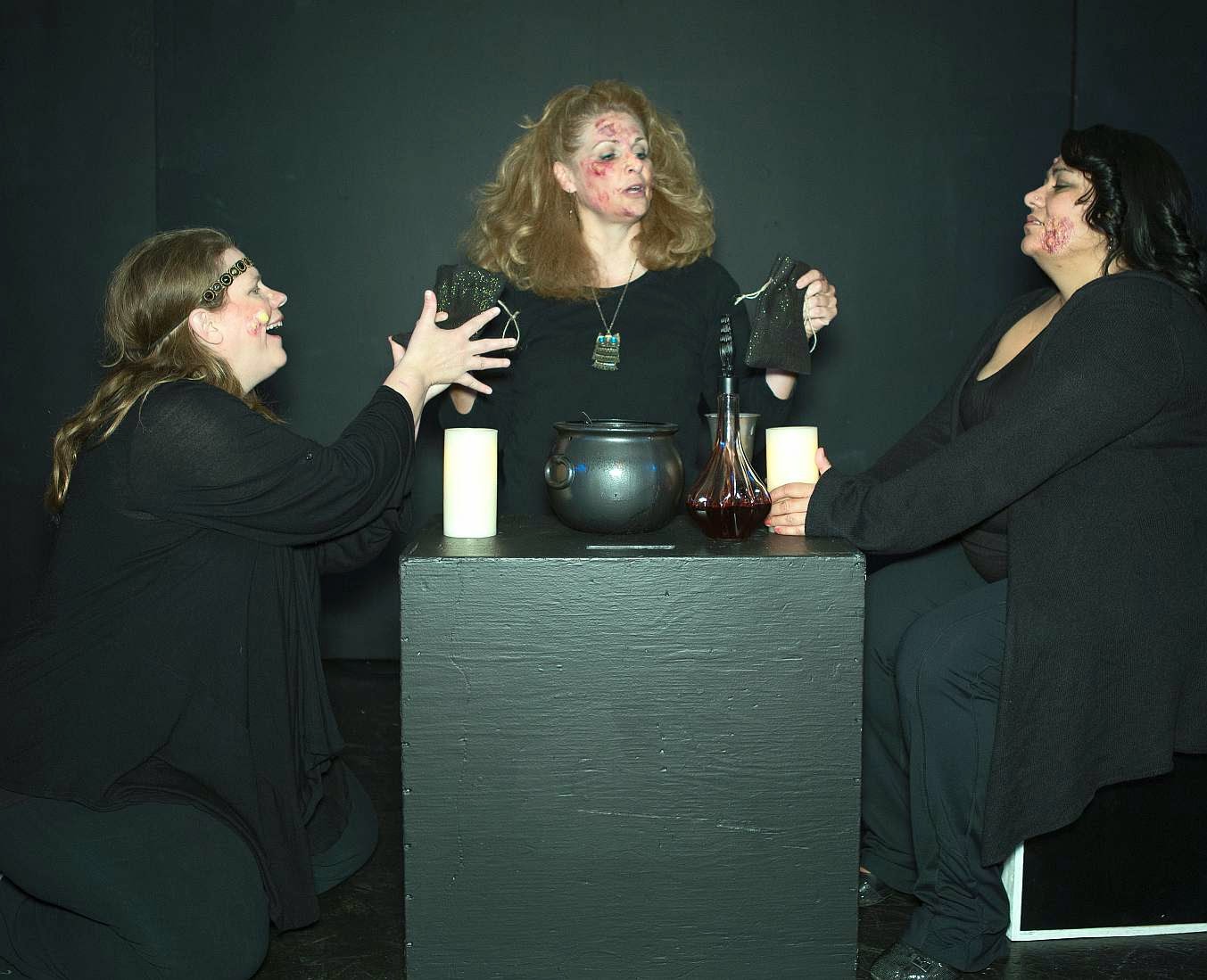
For the lead-off images, I chose something from a very early scene, the dramatic entrance onto stage of the play's three witches. The dramatic lighting and coloring you see is as exactly as you would view it if you were sitting in the audience. The witches reappear in two later scenes, as shown in the first series of images below, including the dramatic opening scenes of the second act when they are joined by John Mortell, who does a splendid job portraying the title character.

A full gallery of images from the dress rehearsal shoot can be found at my site at SmugMug.


Above and next several below: John Mortell displaying the many sides of Macbeth, beginning with the loving, testy and reflective ones while interacting with Lady Macbeth, played by Sally Carter.


Above and next several below: Carter in her turn as Lady Macbeth. For the last shot of Carter in the series, I elected not to use flash and shoot available light to exploit interesting, dramatic (but very low) blue and purple lighting. It might not have been the right call. I boosted my ISO to the max -- 28,000 -- then treated it in noise-reduction software afterward. Even that didn't get me what I had hoped for. But ... at least I know now to avoid ISO 28,000 if I can possibly do so. 


Above and next two below: The slaying of Lord Banquo, Macbeth's onetime ally, by thugs at Macbeth's beckoning partly fails in that Banquo's son, Fleance, also targeted in the slayings, escapes. Macbeth had ordered the killings after the witches told him that Banquo's lineage, and not Macbeth's, would one day rule the kingdom. One of the thugs reports to Macbeth after the assaults.


Above and below: Macbeth's first of two major hallucinations, one of which included seeing the ghost of the vanquished Banquo. 


Above and below: An increasingly paranoid Macbeth, also irked by warnings by the witches to beware of Macduff but also insulted that Lord Macduff did not attend his inauguration, hires thugs to kill Lady Macduff and her children both to send a message to Macduff that subjects must support the new king ... and to ensure there is no lineage in the Macduff family to threaten Macbeth's lineage's claim to the throne.


Above: Macduff, played by Kirk Fields, learns of the slayings of his wife and children. 

Above and next several below: Macbeth prepares to launch into his final paranoid/hallucinatory episode, after intimidating his messenger. 


Above: Macduff finally confronts Macbeth in the play's denouement. A knife fight ensues, and Macduff comes out as the only man standing ... and breathing.