Taylor University is one of the few Indiana places on my “tour” of Indiana small colleges and universities that I was able to visit more than once. The fact that those visits were nine years apart made the trips even more special. But more on that later.
Taylor University began in 1846 in Fort Wayne, Ind., and was founded as an all-women’s college by the North Indiana Conference of the Methodist Episcopal Church. It was called Fort Wayne Women’s College.
Within 10 years, a new branch of the school was opened to which men were admitted, and in short order the two branches merged, resulting in a change of name to Fort Wayne College.
In 1890, the school merged with Fort Wayne Medical School and adopted the name Taylor University in honor of Bishop William Taylor, a Methodist evangelist and missionary. Two years later, the school moved to Upland, where it has been ever since.
In 1992, the university merged with Summit Christian College of Fort Wayne, returning a Taylor presence to that city via an urban satellite campus.
In 2003, Taylor began offering graduate-level programs again after having dropped such degrees nearly 60 years earlier. Since then, the university has expanded its offerings to include a Master of Environmental Science, a Master of Business Administration, a Master of Arts in Higher Education and Student Development (MAHE), and a Master of Arts in Ministry.
Interscholastic sports at the school began in 1932 with baseball, basketball and track and field. In 1948, football was launched, and the university was admitted to the Hoosier College Conference. The school became a member of the National Association of Intercollegiate Athletics (NAIA) in 1995, and two years later, in 1997, the annual December tradition of Silent Night was introduced (follow the link in this sentence to learn more about Silent Night). It is a tradition that in 2010 Sports Illustrated saluted as the best in college basketball.
Taylor University has an endowment of $122.7 million as of 2024, according to College Raptor.
When I first visited Taylor in October 2012, I approached it from the south, exiting I-69 at Indiana Highway 26, also known as Grant County Road 900 South, then traveled east to where 26 takes a 90-degree turn north at 950 East. Highway 26 becomes Main Street once a motorist enters the Upland city limits at 700 South.
As I recall, I entered campus from its eastside and made a quick left turn onto Vayhinger Circle, following its circuitous route along the south portion of campus. I kind of noticed the Memorial Prayer Chapel as I came through a right curve but then quickly noticed the busy activity off to my left in a parking lot outside Odle Arena.
On this game day, the parking lot was jammed with people because at Taylor University, the lot south of Jim Wheeler Memorial Stadium, adjacent to Odle Arena, is where football fans do their tailgating before games.
As I recall, I entered campus from its eastside and made a quick left turn onto Vayhinger Circle, following its circuitous route along the south portion of campus. I kind of noticed the Memorial Prayer Chapel as I came through a right curve but then quickly noticed the busy activity off to my left in a parking lot outside Odle Arena.
On this game day, the parking lot was jammed with people because at Taylor University, the lot south of Jim Wheeler Memorial Stadium, adjacent to Odle Arena, is where football fans do their tailgating before games.
Nearly half of the lot is roped off for an outdoor cookout. Volunteers cook and sell traditional sandwich fare on a couple of large grills, and cooked meats are taken to a large tent and added to a buffet-like spread. Diners queue up to the spread east of the tent after paying a fee for the meal. They proceed through the buffet line and get a beverage from several large tubs with ice before they find a place to sit in the remaining roped off area, where there are several dozen tables set up for sit-down dining.
I ended up parking in the lot near Zondervan Library, then got out and took some shots of the tailgating activity, then went back toward the library to do my campus landscape shots.
Taylor has green mall areas, one on either side of the library. The centerpiece of the larger mall, the one south of Zondervan, is the Memorial Prayer Chapel. A stream, Cane Run, intersects campus just south of the chapel.
The two perpendicular arts structures meet at — and are connected to — Rupp Communications Arts Center. Outside the front of Rupp is a striking memorial plaza encompassing a fountain and three bronze sculptures of former Taylor student Samuel Morris, whose life has served as a model and inspiration for students, faculty and staff at the university in the years since his death in 1893. The photo leading off this post is a full perspective of the fountain and sculpture installation.
Morris had fled Liberia late in the 19th century to escape torture and cruel labor imposed by a chief who had conquered his family’s tribe. Morris had assistance in Africa and the United States to complete the harrowing intercontinental journey.
After arriving in the United States, Morris’ American sponsor connected him with Thaddeus Reade, president of Taylor University, and in 1891 Morris arrived at the Taylor campus, which was then in Fort Wayne. His faith impacted the Fort Wayne community, and his death two years later (he had contracted a severe cold) attracted many local mourners to his funeral and inspired fellow students to serve as missionaries in Africa on his behalf.
The centerpiece of the smaller mall area north of the library, a mall also known as Arts Quad, is the distinctive Rice Bell Tower.
The bell tower caught my immediate attention, so that was the direction I headed when I began my swing through campus. When I finished my shots of the tower, I took a short look/see in the library, a beautiful facility, before emerging and finishing my swing through the Arts Quad, which includes the Smith-Hermanson Music Center on the west and Metcalf Visual Center on the north.
The bell tower caught my immediate attention, so that was the direction I headed when I began my swing through campus. When I finished my shots of the tower, I took a short look/see in the library, a beautiful facility, before emerging and finishing my swing through the Arts Quad, which includes the Smith-Hermanson Music Center on the west and Metcalf Visual Center on the north.
The two perpendicular arts structures meet at — and are connected to — Rupp Communications Arts Center. Outside the front of Rupp is a striking memorial plaza encompassing a fountain and three bronze sculptures of former Taylor student Samuel Morris, whose life has served as a model and inspiration for students, faculty and staff at the university in the years since his death in 1893. The photo leading off this post is a full perspective of the fountain and sculpture installation.
Morris had fled Liberia late in the 19th century to escape torture and cruel labor imposed by a chief who had conquered his family’s tribe. Morris had assistance in Africa and the United States to complete the harrowing intercontinental journey.
After arriving in the United States, Morris’ American sponsor connected him with Thaddeus Reade, president of Taylor University, and in 1891 Morris arrived at the Taylor campus, which was then in Fort Wayne. His faith impacted the Fort Wayne community, and his death two years later (he had contracted a severe cold) attracted many local mourners to his funeral and inspired fellow students to serve as missionaries in Africa on his behalf.
In addition to the sculpture, today there is a campus residence hall named for Morris. (Taylor also named an an academic building for Reade).
The Morris sculptures, a six-year project of artist Ken Ryden of Anderson, Ind., were conceived in 1988 by student Jamey Schmitz and depict key moments in Morris’ life. The statues were placed in a plaza (two are actually in the fountain) and dedicated in 1996 to commemorate the university’s 150th anniversary.
The statues’ titles are The Moment of Truth, depicting Morris at a moment near death when he sees a light in the heavens and hears God’s voice telling him to flee his captors; Heeding the Call, which represents Morris’ flight through the jungle and his commitment to follow God’s will; and Sharing the Word, which illustrates his Christian witness while a student at Taylor.
Because of my intrigue with the library, bell tower and Ryden sculptures, I lost time getting to see and photograph other things on campus, including the Memorial Prayer Chapel and Taylor Lake. I returned to Taylor in May 2021 to rectify both of those omissions and to photograph some new construction that had taken place in the interim.
The Morris sculptures, a six-year project of artist Ken Ryden of Anderson, Ind., were conceived in 1988 by student Jamey Schmitz and depict key moments in Morris’ life. The statues were placed in a plaza (two are actually in the fountain) and dedicated in 1996 to commemorate the university’s 150th anniversary.
The statues’ titles are The Moment of Truth, depicting Morris at a moment near death when he sees a light in the heavens and hears God’s voice telling him to flee his captors; Heeding the Call, which represents Morris’ flight through the jungle and his commitment to follow God’s will; and Sharing the Word, which illustrates his Christian witness while a student at Taylor.
Because of my intrigue with the library, bell tower and Ryden sculptures, I lost time getting to see and photograph other things on campus, including the Memorial Prayer Chapel and Taylor Lake. I returned to Taylor in May 2021 to rectify both of those omissions and to photograph some new construction that had taken place in the interim.
Photographing the Prayer Chapel was important to me because of the story that led to its construction.
In late April of 2006, the driver of a northbound trailer-tractor who had fallen asleep at the wheel crossed the median of I-69 north of the Marion exit and struck a van carrying nine Taylor students and staff members. The horrific accident would lead to an astounding case of mistaken identity of the only student survivor in the van.
Four students, including Laura Van Ryn, and one of four staff members in the van were killed. A fifth student, Whitney Cerak, was so severely injured that her face was heavily bandaged when she was hospitalized in Fort Wayne. An emergency responder at the scene had mistakenly clipped Van Ryn’s university ID to the injured Cerak.
Unfortunately, the parents of the heavily bandaged Cerak were told that their daughter was one of the girls killed in the crash, while the parents of Van Ryn, one of the deceased in the van, were told that Cerak was their daughter. The mixup lasted beyond the victims’ funerals and for several weeks afterward because Cerak was in a coma during that period.
After Cerak regained consciousness, the Van Ryn family noticed peculiarities about the young woman they thought was their daughter. Finally, five weeks after the crash, a therapist asked the injured girl to write her name, and she was able to spell out “Whitney.”
Cerak was able to return to school and graduate from Taylor, according to a 2016 Indianapolis Star story marking the event’s 10th anniversary. She married her longtime boyfriend, Matt Wheeler, and the couple have three children.
The driver of the rig, Robert Spencer, would be charged with five counts of reckless homicide, pleaded guilty and served two years of a four-year sentence. Investigators found that Spencer had falsified his time logs and had been on the road nine hours longer than allowed under federal law. The case would prompt Indiana lawmakers to enact stricter guidelines on coroners in identifying victims in fatal crashes.
On April 26, 2008, the university dedicated the chapel to honor those who died in the traffic accident but also to serve as testimony by the whole university community — administrators, faculty, students, staff, alumni and friends — to their commitment to prayer and its importance in everyday lives.
Since my 2021 trip to Taylor, I have made separate galleries of campus images at my site at SmugMug.com for each of the visits. To view photos from the 2012 visit, follow the link in this sentence. To view photos from the 2021 visit, follow the link in this sentence.

Above: Inside Zondervan Library.


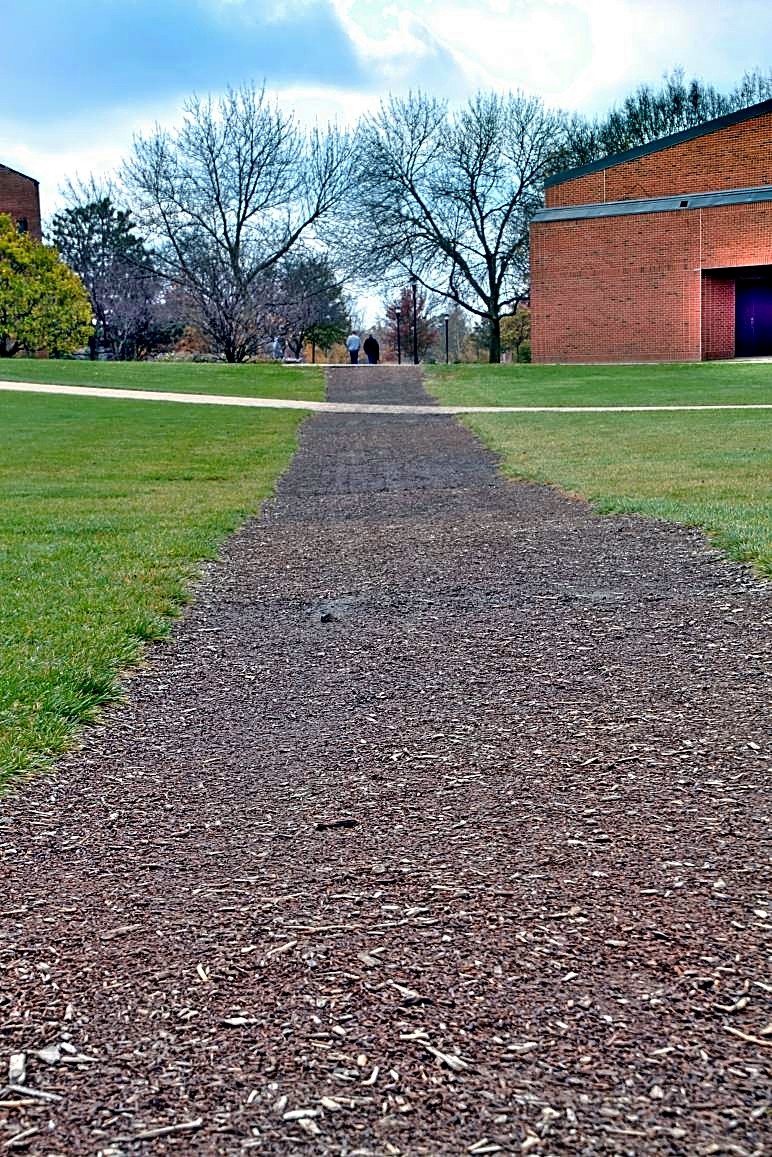


Above: Ayres Alumni Memorial Hall.


Above and below: Breuninger Residence Hall, which is attached to Gerig Residence Hall. Breuninger opened in 2013. A waterfalls formed by Cane Run (second photo below) and a collection pond (third photo below) are near Breuninger-Gerig.


Samuel Morris Residence Hall (above) and Helena Memorial Hall (below). The latter is home to the admissions office and offices of the university president and provost.


Next up: Chapter 13, University of Indianapolis vs. Delta State (Miss.), Nov. 2012
Previously in Game Day Revisited: