Showing posts with label Macbeth. Show all posts

Monday, October 27, 2014

3 shows remain in First Folio's run
of Shakespeare's Macbeth

The final three shows of First Folio Productions' fall drama, "Macbeth," the classic Shakespearean tale of evil, will be performed this week.

Show director Susan Yeaw, whose production opened last weekend at Studio 15 in Carmel, invited me to shoot the dress rehearsal on Oct. 20, and since then I've been turning around and delivering images to the troupe and Carmel Theatre Company so they can promote the two weekends of shows. First Folio has used several of my images on social media (Facebook, Twitter). Just today, I completed processing the last of the images, so I thought I'd try to get a post up on Photo Porpourri to help spread the word.

This shoot was the most difficult of the dozen or so theatrical productions I've photographed since 2010, primarily because of the frequent and dramatic stage lighting shifts between scenes. One moment, lighting would be what I would describe as relatively normal then shift to pitch black with little time to adjust camera settings to be prepared.

In pursuit of optimum-quality images, I was bouncing back and forth between shooting at available light with high ISOs for the better-lighted scenes, to diffused on-camera flash for the all-dark scenes, the latter using a Canon 580EX II strobe.

Fortunately, my Canon 6D camera had the quality ISO levels to deliver presentable images at most of the ISO settings I turned to, and the Graslon Insight flat amber diffuser (pictured at right) I used on the 580EX II did a great job of lighting my subjects even though I did need to tinker with the intensity and zoom levels periodically.

If you're new to this blog, I wrote two posts mentioning the Graslon diffusers in 2013; the link in the previous clause takes you to the second of the two. Just revert to the post immediately before that one to find the first post. I own Graslon's Insight (flat) and Prodigy (dome) diffusers in both white and amber, and I own a Graslon white Spark that slides onto the hot shoe of my Canon 7D to diffuse light from that camera's pop-up flash. The Insight and Prodigy slip over the flash heads of an on-camera flash. If you need professional light but don't have the time to set up stands and strobes, or because of logistics (such as plays on stage), these Graslons -- especially the Insight and Prodigy -- with a wonderful mirror redistribution light system for on-camera flashes do a great job of delivering the next-best thing.

I was also changing my ISO levels between the high zones for available light to much lower noise levels for flash. I also was changing my shutter speeds between the two lighting sources, going higher in available light (mostly 1/180 to 1/200) to stop action as much as I could, and lower speeds (usually 1/80) for flash to allow for greater background detail to be included when I could. Flash stops most action at speeds of 1/60 or faster anyway. My main concern in switching back and forth so much was that I would forget to remember to return the shutter to the higher speeds when going from flash to available light.

And, alas, that did happen when I started shooting a crucial fight scene near the end. When processing the images at home, I was tossing out a lot of frames because of unwanted blur, although I did preserve a few in which the blur seemed to work.

"Macbeth" can be seen at 8 p.m. this Thursday, Friday and Saturday. Studio 15 is at 15 First Ave. N.E., a block north of Main Street in the heart of Carmel's Arts and Design District.

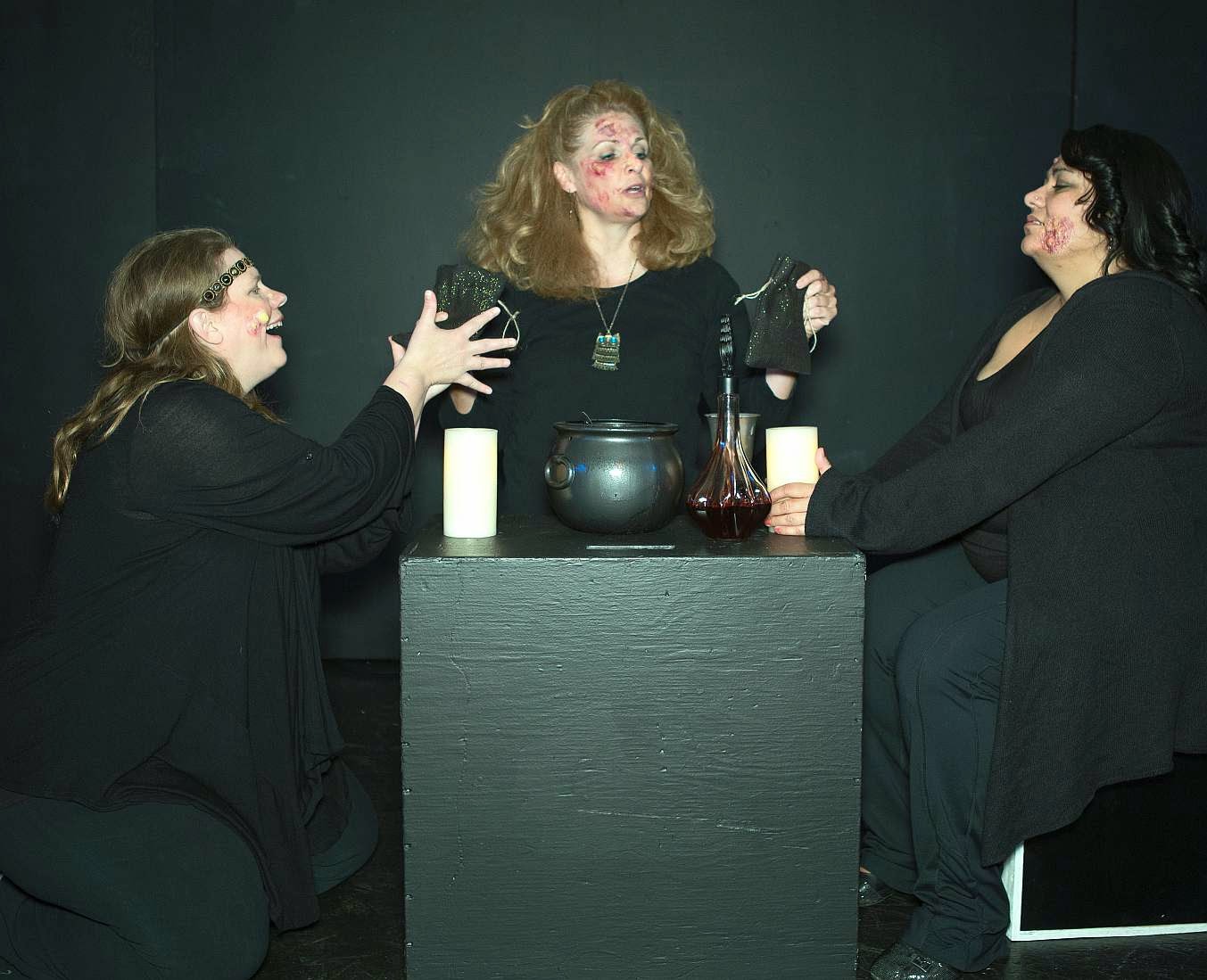
For the lead-off images, I chose something from a very early scene, the dramatic entrance onto stage of the play's three witches. The dramatic lighting and coloring you see is as exactly as you would view it if you were sitting in the audience. The witches reappear in two later scenes, as shown in the first series of images below, including the dramatic opening scenes of the second act when they are joined by John Mortell, who does a splendid job portraying the title character.

A full gallery of images from the dress rehearsal shoot can be found at my site at SmugMug.


Above and next several below: John Mortell displaying the many sides of Macbeth, beginning with the loving, testy and reflective ones while interacting with Lady Macbeth, played by Sally Carter.


Above and next several below: Carter in her turn as Lady Macbeth. For the last shot of Carter in the series, I elected not to use flash and shoot available light to exploit interesting, dramatic (but very low) blue and purple lighting. It might not have been the right call. I boosted my ISO to the max -- 28,000 -- then treated it in noise-reduction software afterward. Even that didn't get me what I had hoped for. But ... at least I know now to avoid ISO 28,000 if I can possibly do so. 


Above and next two below: The slaying of Lord Banquo, Macbeth's onetime ally, by thugs at Macbeth's beckoning partly fails in that Banquo's son, Fleance, also targeted in the slayings, escapes. Macbeth had ordered the killings after the witches told him that Banquo's lineage, and not Macbeth's, would one day rule the kingdom. One of the thugs reports to Macbeth after the assaults.


Above and below: Macbeth's first of two major hallucinations, one of which included seeing the ghost of the vanquished Banquo. 


Above and below: An increasingly paranoid Macbeth, also irked by warnings by the witches to beware of Macduff but also insulted that Lord Macduff did not attend his inauguration, hires thugs to kill Lady Macduff and her children both to send a message to Macduff that subjects must support the new king ... and to ensure there is no lineage in the Macduff family to threaten Macbeth's lineage's claim to the throne.


Above: Macduff, played by Kirk Fields, learns of the slayings of his wife and children. 

Above and next several below: Macbeth prepares to launch into his final paranoid/hallucinatory episode, after intimidating his messenger. 


Above: Macduff finally confronts Macbeth in the play's denouement. A knife fight ensues, and Macduff comes out as the only man standing ... and breathing. 


Saturday, December 7, 2013

Looking back ... on PP's 5th anniversay

This month marks the fifth anniversary of the launch of Photo Potpourri, and I thought I'd observe the occasion with a couple of posts indulging in a familiar pastime known as "looking back." I'm going to start with a post that provides a sort of behind-the-scenes peek that I doubt many bloggers would offer readers.

Blogspot, Photo Potpourri's Internet host, provides blog operators and managers various statistics to monitor traffic, as well as to ascertain where traffic is coming from, what is popular and how often people land at the site. I now look in on this data at least every other day to help me determine if I'm offering content of value or worth. I'm pleased to say that traffic has increased through the years -- very gradually the first four years, and by quite a lot this past year.

I've had just over 400 posts since the inaugural one in December 2008 (a post that, ironically, did not carry a single photograph!). That's an average of 80 posts per year, and there have been just under 90,000 hits on the various pages of the blog in that time.

The most viewed post (also known as the post with the most "hits") from as long as I have been following the data has been an interview I did of Indianapolis wedding photographer Rich Miller (left) for Photo Potpourri's former "Photographer in the Spotlight" feature. The Miller interview, which featured some of Rich's great work, went online Nov. 19, 2009. That post, in fact, has been a rock solid No. 1 "hit" -- its total hits (in the four-digits realm) more than doubles that of the runner-up post in hits, also in four digits, which was a recap of the Garfield Shakespeare Company's production of Macbeth (below), staged in a colonial America setting, in September 2010.


My theory on the popularity of the Miller post is that either Rich recommends it to potential clients who inquire about his services, or that potential clients find and check it out while researching possible photographers. My initial guess had been that Rich had a link to the post on his business's website, but when I visited his site to see if that were the case, I couldn't find any such link, so I don't think that's driving the traffic.

Those of you unfamiliar with the former "Photographer in the Spotlight" feature, whose run ended in May 2010, might find the monthly installments interesting reads -- and will introduce you to photographers you might never had come across. Just click on "Spotlight" from the Labels list on the right side of this blog's home page -- or click on the link in the first line of this paragraph -- to bring up all the profiles in the series.

Ranking third on this blog's all-time most-visited-post list is a piece I wrote (with pictures I took) about basketball player Chrishawn Hopkins after his debut performance for the Butler University men's basketball team in November 2010. The hits on that post -- now also in the four digits -- increased hugely two years later when Hopkins left the team for unannounced reasons. Hopkins transferred to Wright State University in fall 2012, and this fall, after sitting out a year, he began playing for the Raiders in his third year of college eligibility.

The fourth-most visited Photo Potpourri post went up Dec. 26, 2012. It was about the oddity of so many tilting trees in Garfield Park, such as the one below, on the Southside of Indianapolis. The fact that it got that many hits in a much shorter time span than posts Nos. 1-3 is remarkable ... but not as remarkable as the meteroric popularity of the post at No. 5.


My report and pictures about the scenic campus of Rose-Hulman Insitute of Technology, a post just barely two months old as of this writing, easily scored the most hits in the shortest time span of any post ever at this blog. I think the explanation is that I had included a link to the post (and to two others I did on Rose-Hulman during my visit there on Sept. 21 of this year) in an email to Dale Long, the school's director of news services. I was doing a followup inquiry to ask for help identifying students in the school's homecoming court whom I photographed during halftime of the Fightin' Engineers football game against Defiance College. The post was lush with images of the scenic campus, including the shot below of Percopo Hall (left) and White Chapel (right) along Speed Lake, and I'm guessing Long shared the link with school officials, students and acquaintances, who in turn passed it along, etc.

Friday, September 17, 2010

Shakespeare's Macbeth, in a colonial setting


Today and tomorrow are the last performances of "Macbeth: A Colonial Tragedy," the latest presentation of the three-year-old Garfield Shakespeare Company. The shows will be at 8 p.m. in the MacAllister Center of Performing Arts amphitheater in Garfield Park, Indianapolis.

These images were taken at the show's opening night, Friday, Sept. 10, 2010. Director Thomas Cardwell's production is set in pre-revolutionary war America, hence the "colonial" reference in the title.

The picture at the top is in the second half of the production, a dramatic scene when Macbeth, played by Eric MacDonald, has a disturbing vision in which he sees a procession of kings from the lineage of his onetime friend Banquo, as prophesied by the three witches.

Best thing about the shows: They're free!

A full gallery of images from my shoot of "Macbeth" is available at my online site at SmugMug.com.


The three witches -- or "weird sisters," as Macbeth refers to them in the play -- during a dance while concocting a brew. Their prophesies are key elements in the play: That Macbeth would become Thane of Cawdor, putting him first in line to succeed King Duncan; that Banquo, Thane of Lochaber, would never sit in the throne, although Banquo's lineage would assume the throne, a prediction that would disturb Macbeth and, along with Lady Macbeth's goading, motivate him to kill Banquo, his onetime friend; that Macbeth would never be harmed by anyone "born of woman"; and that Macbeth should beware of Macduff, Thane of Fife, whose family and servants are put to death at Macbeth's direction. Macduff eventually kills Macbeth after divulging to Macbeth a shocking technicality that enables Macduff to circumvent the witches' pronouncement: Macduff says he was not naturally "born of woman" (through the birth canal), but was "ripped" from his mother's womb (Cesarean section).


King Duncan, played by Stephen Scull, talking to Lady Macbeth. Later in the drama, Duncan is slain by Macbeth.


Lady Macbeth, played by Meagan Matlock, trying to persuade her husband to kill the king so he can take over the throne.


Macbeth, in blood-stained shirt, during a tortuous reflection in the aftermath of his late-night slaying of King Duncan in the king's chambers.


Macbeth and Banquo, played by Charles DiGiovanna, converse in a scene after Macbeth had killed King Duncan. Not longer after, Banquo would be slain at Macbeth's direction, although Banquo's son Fleance -- also an assassination target -- would escape, allowing the fulfillment of the witches' prophecy that a long line of Banquo's lineage would ascend the throne.


Macbeth's onetime friend Banquo (left), returning as a ghost -- seen only by his slayer Macbeth -- at a banquet, a scene befuddling everyone else at the table who cannot understand why Macbeth is raging at an empty chair.


Lady Macduff, played by Melissa Mowat, shortly before she and her child are killed at the direction of Macbeth, who is trying to heed the witches' prediction to beware of the exiled Macduff.


Macduff, played by Nick Henry, announcing the beheading of Macbeth.