Saturday, June 7, 2014

The tragedy of Romeo and Juliet

I just completed one of the most challenging shoots I've ever had, largely because of the volume of images to process ... and the goal to turn over the completed JPGs as soon as possible.

First Folio Productions, which is nearing the end of its late-spring run of William Shakespeare's Romeo and Juliet at Ben Davis High School on the Westside of Indianapolis, asked if I would shoot its dress rehearsal and also take some "behind the scenes" photos. I've done considerable photographing of theater, until now almost exclusively for the Garfield Shakespeare Company, which is based in Garfield Park on the Southside of Indy.

I decided to do it, largely because I would have the opportunity to shoot in a traditional theater environment, and I was eager to see if the qualify of my images would be affected by the traditional lighting and the kinds of shot angles I would have there. The play's director, Glenn Dobbs, promised me unfettered access on the stage to grab what I needed, except for two sword combat scenes about which he was worried that I would have trouble getting out of the way if I were too close. (GSC, by thee way, uses an outdoor amphitheater for its late-summer/fall shows, and the floor of the main gallery hall of the Garfield Park Arts Center for its spring shows.)

I ended up shooting more than 4,500 images using two Canon cameras -- a 6D mounted with a Canon 24-70mm f/2.8L lens, and a 7D equipped with a Canon 70-200mm f/2.8L IS lens. Both cameras also featured two new B+W ultraviolet lens filters (thanks, Greg Mitchell).

The quality of photos amazed me, even though the post-processing proved laborious because of the ever-changing and uneven stage lighting that challenged me to find balance and proper levels with a good number of shots taken at the dress rehearsal on Tuesday, May 27. I was constantly changing ISO levels to adjust to the light change. I'd committed to shooting at shutters of 1/250 to 1/320, which were much faster than I had used over the years for GSC, when I often settled for 1/160 (and sometimes less) out of necessity because the lighting for its shows was less intense (although I will note that lighting GSC's production of Antigone this spring did seem as if it had gone up a notch in intensity). But having the 6D, with its superior light-sensitive sensor, as my primary camera enabled me to take such a risk ... and not regret it. I turned to noise-reduction software for only about four dozen or so of all the images I made, and many of those came in the shots taken in the behind-the-scenes shoot on Wednesday, May 28 ... or when nearly all of the lights in the house were down, and a simple spotlight was used to illuminate a performer or performers.

I made my pictures available to Glenn as I plodded through the batch, and he dipped into them to promote the shows in sundry Facebook blasts and at the company's Facebook page in the days following the shoot and through this weekend's final shows. There is one more performance remaining -- at 2:30 p.m. Sunday. You can find ticket information at the above link. I'll publicly open the gallery I provided to him as soon as I hear that he is finishing dipping.

Early on, Glenn seemed most interested in shots from the several combat scenes in the production, and it was clear that Glenn, First Folio and the cast members involved spent considerable time mastering the sword and foot work required to make the combat appear convincing. I chose the one to lead off the post because of the lighting involved -- the dark, blue tone was used to help convey the fact that the actors, Jurrell Spencer (left), who played Count Paris, a suitor to Juliet, and Anderson Parker, who played Romeo, were situated in a tomb in the scene near the end of the play.

Here's a look at some of the images. You can find others at the theater company's Facebook page or visit a gallery featuring the full shoot at my site on SmugMug. I'll look to present a few images from the "behind the scenes" shoot on May 28 in a future post.

Above and next five below: The festive scenes in the play feature these dance routines by the full cast ... and is where Romeo and Juliet, played by Michelle Wafford Mannweiler, also connect for the first time. This series includes one of the few black-and-white conversions I made of the images.


Above: Anderson Parker conveying Romeo in a contemplative mood during a conversation with close friend Benvolio (Mike Varick).

Mercutio (Tim Fox, left) and Benvolio are good friends of Romeo. Mercutio is fun-loving and apt to press people's buttons in the quest of a good time. He challenges Tybalt, Juliet's cousin, after Romeo receives a death threat from Tybalt but refuses Mercutio's urging to fight Tybalt. Mercutio fights Tybalt himself, with unfortunate consequences. Mercutio's playfulness is featured in the two shots below.


Rosaline (played by Kathleen Charek), Romeo's love interest until he sees Juliet, uses a strategically placed kick to set straight one swordsman (Jeff Sanford) during the play's first fight scene.

Above and below: The first fight scene featured multiple swordsmen simultaneously clanging weapons.


Above and next five below: This series could be subtitled "The Many Faces of Holly Hathaway," who played Juliet's nurse. These selections scratch the surface of Hathaway's animated expressions captured during the rehearsal. As a sidebar, from what I understood, the nurse's costume was not ready at the time of this rehearsal, so cast members (possibly even Hathaway herself) were joking that Hathaway's plaid shirt had transformed her role to that of a lumberjack hussy (although they used a slightly more vulgar term). Carrie Reiberg as Lady Capulet (in red dress) pulled off a few striking expressions herself in these images.


Above and next two below: Shots from the balcony scene.


Above and next three below: Mercutio's run of prankish behavior comes to an end in his duel with Tybalt (played by John Mortell), beginning (above) with one last vulgar gesture. It ends in the third image below, with Tybalt's second of two thrusts into Mercutio's midsection.


Above and next two below: After witnessing the demise of his friend Mercutio, Romeo takes up the sword and gives Tybalt his just due, also with two avenging jabs to the midsection.


Above and next two below: The first and second halves of the show open with musical interludes provided by vocalist Rachael Whitlock and guitarist/vocalist Al Hoffman. The frame above and below are from the opening of the second half. The second shot below was taken with an ultra-wide-angel lens, a Sigma 10-20mm f/3.5.


Above: The play's denouement begins when a despairing Juliet swallows a potion intended to put her in a temporary coma-like state so she can feign death to avoid marrying Count Paris at her father's insistence. She gets the potion from Friar Laurence, who promises to get a messenger to Romeo to inform him of the plan. But the messenger doesn't make it to Romeo in time before Romeo hears of Juliet's apparent death. Juliet's parents (first photo below), Lord Capulet (played by Tristan Ross) and Lady Capulet, also are unaware of the ruse. The friar isn't about to clue them in, as he helped Juliet hatch the plan.   


Above and next five below: Romeo discovers what he believes to be a deceased Juliet, kisses her goodbye, downs a lethal poison that he had obtained from an apothecary after learning of Juliet's alleged demise, then collapses to the floor. When she awaks, Juliet discovers Romeo -- and his empty bottle -- and decides to end her life as well, using a short-blade sword before collapsing onto Romeo. 


Above: Lord and Lady Capulet and others discover Julie a second time, this time mortally wounded.

Tuesday, May 6, 2014

Tulips splash color into garden

Photographing flowers and plants. Most photographers have been there and done that, right? And most of us indulge the experience because one gets pretty pictures, because the subject never complains or runs away (although holding still in a gusty wind is another matter), and because in many cases, it's convenient and stress-free.

I cite all of the above as reasons for my annual (short) trek to the gardens at my home, where my violet and marble-orange tulips in the circular garden and the stalwart red tulips in the rear fence-line garden greet me when I gaze out the kitchen window during their short spring run.

Asparagus along the north fence line garden already is inching skyward. This is year three for the asparagus, and I think I could have harvested some of that last year, but I resisted. In the genus garden, I miss my purple and amber crocus, which I inadvertently removed a few summers ago while planting vegetables nearby. I also lost a couple of blue- and lilac-colored hyacinth in the process.

The lone white-petaled crocus that survived my inadvertent plant removal seems very lonely each year when it makes its short splash, which usually comes in very early March but was delayed a few weeks this year thanks to the extended frigid weather. White color, by itself, doesn't light up the otherwise spartan garden at that time of year as the color combo had done in previous years. I haven't bothered to restock my crocus since; I haven't decided yet that's what I want there permanently.

In June, I'll have the spectacular yellow and pink Asiatic lily show, also along the north fence line. This year, they'll be joined by a couple new lilies that I planted last fall (I've honestly forgotten the color). Not long after that, there'll be lots of potential photo subjects to pursue from the other fruit and vegetable plantings -- strawberries, broccoli, cauliflower, tomatoes and cucumbers. My big curiosity is whether the blueberry bushes will finally give me something to talk about (OK, and consume) this year, their third in the rear garden. I'm beginning to wonder if I maybe gave the blueberries a bad growing spot ... or if, perhaps, the bird kingdom simply is beating me to all of it. I do know the blueberry bush is giving me a nice spring floral show, and there are a couple pictures of that here.

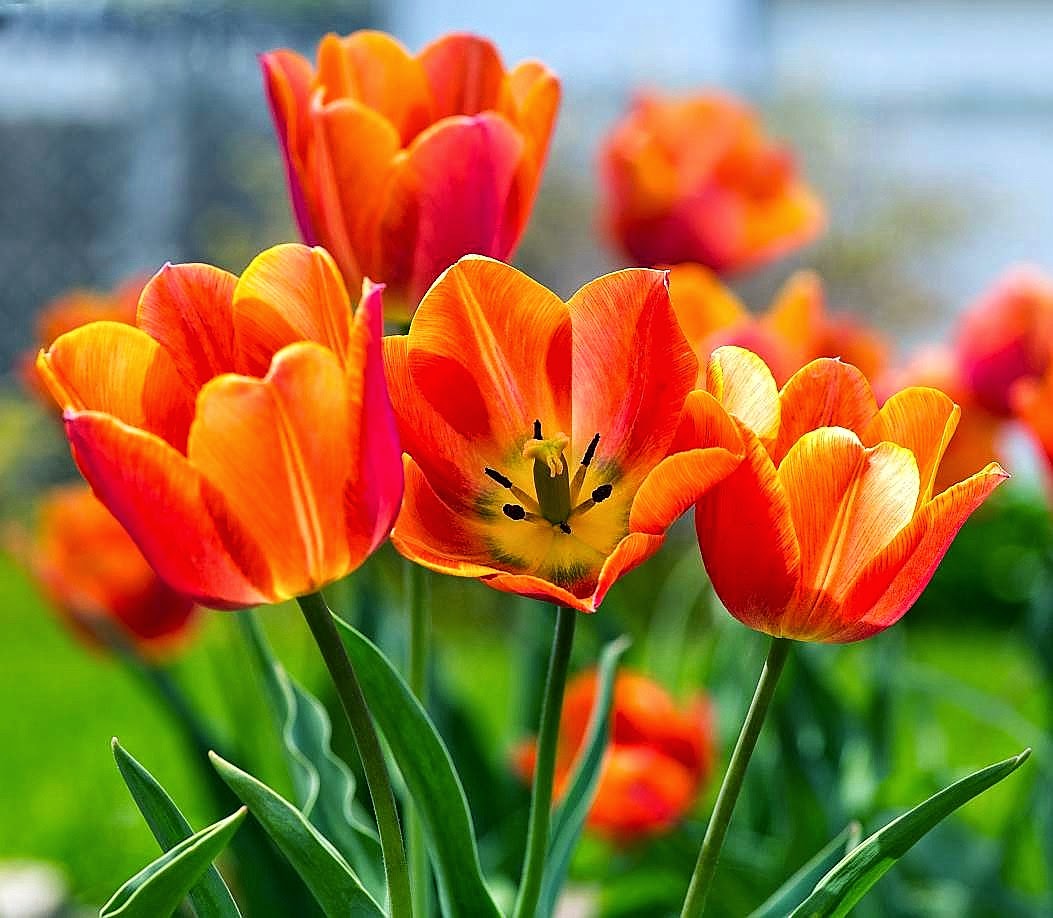
For this post, I present the tulips, blooms from a white-and-gold trumpet daffodil and the buds from the blueberry bush. I used my Canon 6D and Sigma 105mm f/2.8 macro lens in aperture-priority setting during the April 29 shoot. I stuck within the f8-11 range, with a shutter speed defaulting to 1/80 to 1/160. Occasionally, the shutter would get slower, in which case I would adjust the ISO, which ranged from 100 to 160.

It's always a challenge to find new or "different" things after photographing flowers so much. This time, I went for such things as elegenace (notice the tall-stemmed purple tulips); the curved forms from the strong wind; dappled light through branches of the red bud tree that shares the circular garden with the orange/purple tulips; different backgrounds (the light wooden fence you see is new -- my new neighbor installed it last fall); and various groupings. There was even a "pose" where it looked like one tulip bent by a strong gust was supporting -- "cupping," almost -- a neighboring bloom. I enjoyed that. I include a perspective shot of the circular garden so you can appreciate the clustering ... and see the bottom of the red bud tree.

The red tulips in the rear fence-line garden were nearing the end of their annual run when I did this shoot. They lasted only a couple days more afterward. The orange/purple tulips, however, are still looking strong.

As always, to see a larger and sharper version of the image, click on the image. The sharpness factor especially applies to those accessing the blog via mobile device.