Before I visited Colonial Williamsburg, Va., on Sept. 28, I'd heard snippets about the popular, revolutionary era tourist attraction, but I can't say I remember ever seeing
pictures of it.
Also, I didn't do any research about it before heading there, nor did I realize -- before I actually was standing at the far west end of Duke of Gloucester (Main) Street -- that the campus of the historic College of William and Mary was sitting right next to it, picking up where main street ended.
At the far west end of Duke of Gloucester Street, there is a modern, block-long amalgam of shops that serves as a transition from Colonial Williamsburg to the college. I was still oblivious to William & Mary's proximity when I walked into a bookstore at the east end of those shops and, to my left, saw an area loaded with William and Mary logo merchandise for sale. The light bulb went on, so I pulled up my locale on my smartphone and verified ... William and Mary was a short block away (in retrospect, the "William and Mary" name on the bookstore outside should have tipped me off before I ever entered, but I didn't notice it until after leaving the store). More on William and Mary in the next post.
Colonial Williamsburg was not what I had envisioned. I had pictured a compact area of narrow, cobblestoned streets lined with tightly packed homes -- perhaps what I remember seeing last year in Charleston, S.C. I had no mental imagery of what a commerce area would look like.
Colonial Williamsburg has a much wider -- and paved -- dominant main street along which are sprinkled shops, quite a few taverns, a church or two, a community marketplace. Some of the structures are, indeed, packed tightly together, but there is separation between others. And most of all, Colonial Williamsburg 2016 features a mix of original and either restored or newly built structures made to look like they would have in the days of the Colonies.
Because Colonial Williamsburg is a tourist attraction that needs revenue to maintain its facilities and pay people to provide information to visitors, there are fees to pay if you want to do more than just walk through the town unguided (which I did). The fee schedule varies, depending on what you want to do. If you're interested,
follow this link to see your options.
I was content with roaming on my own and photographing things I had access to. If I went again, and weren't primarily interested in photography, I might opt for one of the tours.
In general, I was slightly disappointed in the town as an attraction. Perhaps I would have been more taken by it had I invested in one of the tour packages. I was most impressed with the former capitol building (see photo leading off the post) at the far east end of Duke of Gloucester Street, and the Governor's Palace and pre-revolution British royal residence on Scotland Street at the end of the Palace Green, a few blocks north of Duke of Gloucester. I couldn't get inside either structure without a ticket, so getting into those two structures might make the basic tour ticket worthwhile.
Also of interest was the Bruton Parish Episcopal Church lot, which carried a sign indicating that it is not always accessible. It was on the day I was there, however.
I did visit the Colonial Williamsburg Regional Visitors Center, a modern facility on the north end of the attraction and has ample parking and provides shuttles to the heart of the old community. However, I did not park there. I parked in a lot closer to Duke of Gloucester Street. The visitors center has a very large merchandise shop and is one place where you can buy tickets to the various tours as well as memberships, which no doubt are most appealing to those who live near the area.
Photo geek stuff: I shot all of my images in Colonial Williamsburg with a Canon 6D equipped with a Canon EF 24-70mm f/2.8L lens. I bracketed my shots for three exposures of each scene, melding them into one using Photomatix high-dynamic range (HDR) software in post-processing. As always, I used my shutter speed as the exposure variable for the bracketing; my aperture was set at f/8. I had varying degrees of sunlight due to partly cloudy skies, so ISOs ranged from 160 to 500.
To see
a full gallery of my shots from Colonial Williamsburg, visit my site at SmugMug.com. Because I finished processing of only 80% or my photos from this shoot, you can check back to the gallery later to see others I will eventually add to it. And as always, to view a larger and sharper version of a photo in a post, click on the picture. This is especially important if you access the post from a mobile device.
The side of the Capitol building (above) facing Duke of Gloucester Street, which is opposite that featured in the lead-off image. Below are two closeup shots from the capitol grounds, the cupola (first below) and ornamentation on the iron gates (second below).
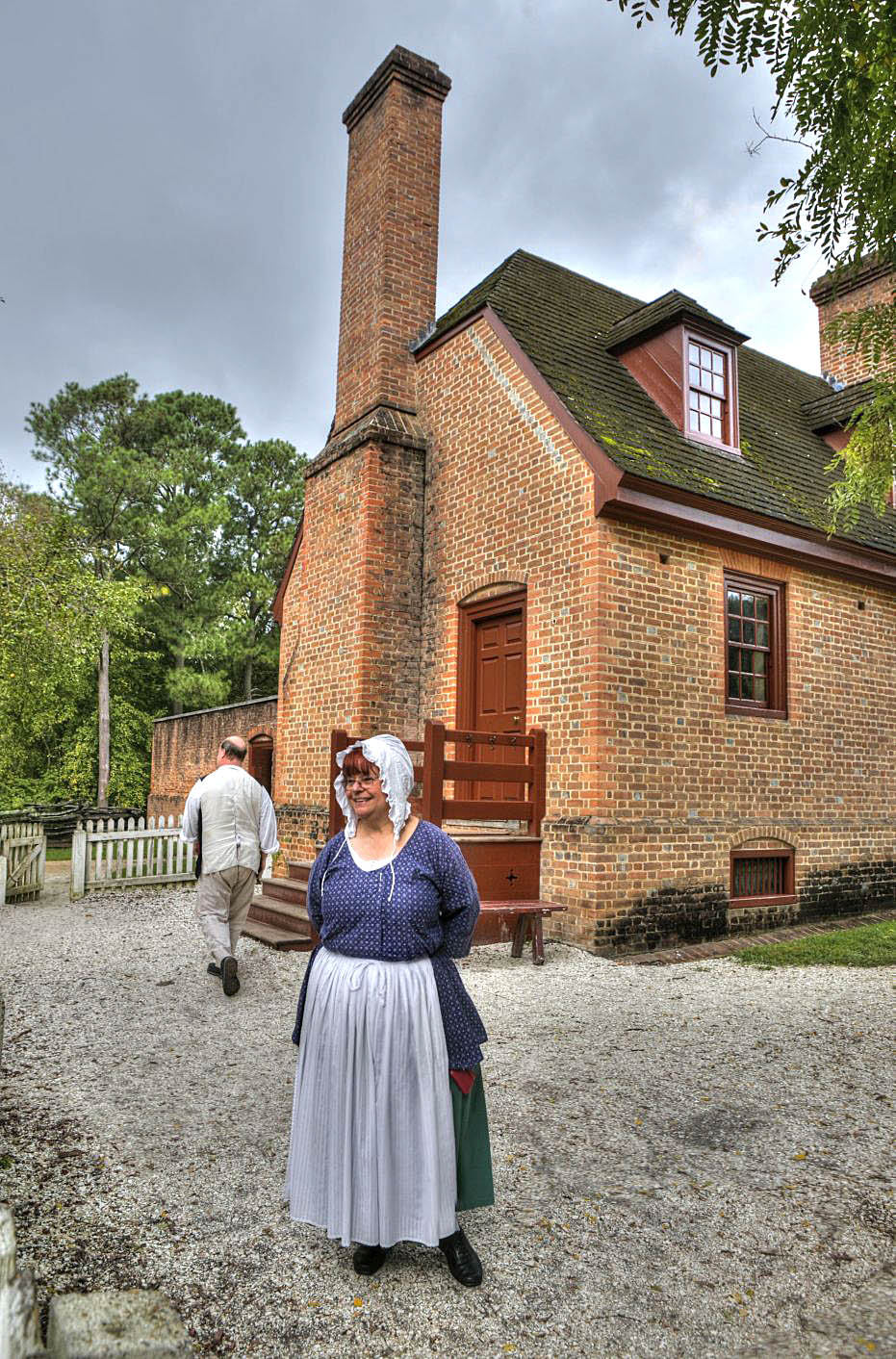
Above and next two below: Part of enjoying Colonial Williamsburg is seeing staffers dressed in period garb walking the streets as they did in the 1700s. I liked the photo above because it has people from both eras represented ... even though the girl in the background was a cameo. The colonial-dressed man in the first photo below was quite animated in his conversation with the visitor, and I liked getting the umbrella lady in the second photo below facing the camera with a genuine smile.
I entertained notions of converting pictures of the two sides of this building to monochrome the moment I took the photos. The monochrome versions were not part of the original full gallery at SmugMug, but are being added now. But the gallery does have the original colors, so if you're curious about what the color versions look like, that's where to go. My only reservation about the above image is that the two gentlemen sitting along the building are not in period garb.
Above: Two more people in period garb chatted briefly as I photographed the building in the background from the left side of this perspective. When I moved to the position of this photo, the gentleman took off but the lady bravely stuck around. The building was the Public Gaol, which according to a sign nearby, was Virginia's chief jail, holding debtors and criminals and where Blackbeard's pirates, captured in 1718, were kept until the day of their hanging.

Above and next four below: OK, I guess I was really struck by the period garb thing. Above are four more staffers who were hanging out at this point on the east end of Duke of Gloucester Street, and they didn't seem to mind me photographing them. The first photo below gives you a little idea of how many people already were on the grounds when I started my self-guided tour. These people were watching a one-person show by a gentleman who was dressed, I'm sure, as one of the prominent statesmen (he kind of looked like Thomas Jefferson), but this was strictly a drive-by shoot. I grabbed my two shots and left. It's probably the only time during the day I wished I would have had my 70-200mm lens for some shots. Soon after I left the one-man show, I photographed the costumed man in the third photo below. He was perfectly willing to pose, and pose he did!


Above and next five below: Examples of some of the shops along Duke of Gloucester Street, although from the nice condition of the building above and the first one below, I have to believe those were reconditioned, rebuilt or totally new. The ticketed tour gets you a guide that helps you identify which are originals, which are reconditioned and which are new construction made to look like colonial architecture.
Above and below: More costumed staffers, including the umbrella lady below, who appeared to be in an interview with someone.
Above: I composed this shot to offer perspective on the distances between shops and from sidewalks to street, and to illustrate the width of the street. The building in the far background, at the east end of Duke of Gloucester Street, is the former Capitol.
Above: People can experience what it was like to be confined in the stocks ... and grab a scrapbook photo in the process.
Above: The old post office.
Above: One of the ways you can view the town is by carriage ride, although it, too, comes with a price.
I detoured off Duke of Gloucester Street, turning north to make my way toward the Governor's Palace, and came upon the building above. The lock in the detail shot below was on the building's door. Before reaching the building above, I came upon a modest pasture where cattle grazed (second below).
Above: A lock on the doors of the building pictured immediately above. The color version of this also is in the SmugMug gallery.
I resigned myself to the fact that a photo of the full view of the Governor's Palace (above) on Scotland Street is almost impossible without tourists getting in the image at some point. Below is a closeup of the cupola.
Above: I came across this costumed gentleman outside a residence along the Palace Green as I made my way back to the main street.
Above and next two below: On the grounds of Bruton Parish Episcopal Church.
Above: A costumed staffer working a garden at the wend end of Duke of Gloucester Street.

 To me, the second half of the Sunken Garden (right) moniker is curious. The attraction certainly is distinguished, and the mall's level is below that of the walks and buildings surrounding it (indeed, you must climb and descend stairs to enter and leave it). But there is no "garden" in the traditional sense; it is an open meadow of lawn and brick walking paths, no tress, bushes or benches to sit on, although there are plenty of benches along the elevated paths surrounding it. That is what makes it unusual, I guess.